
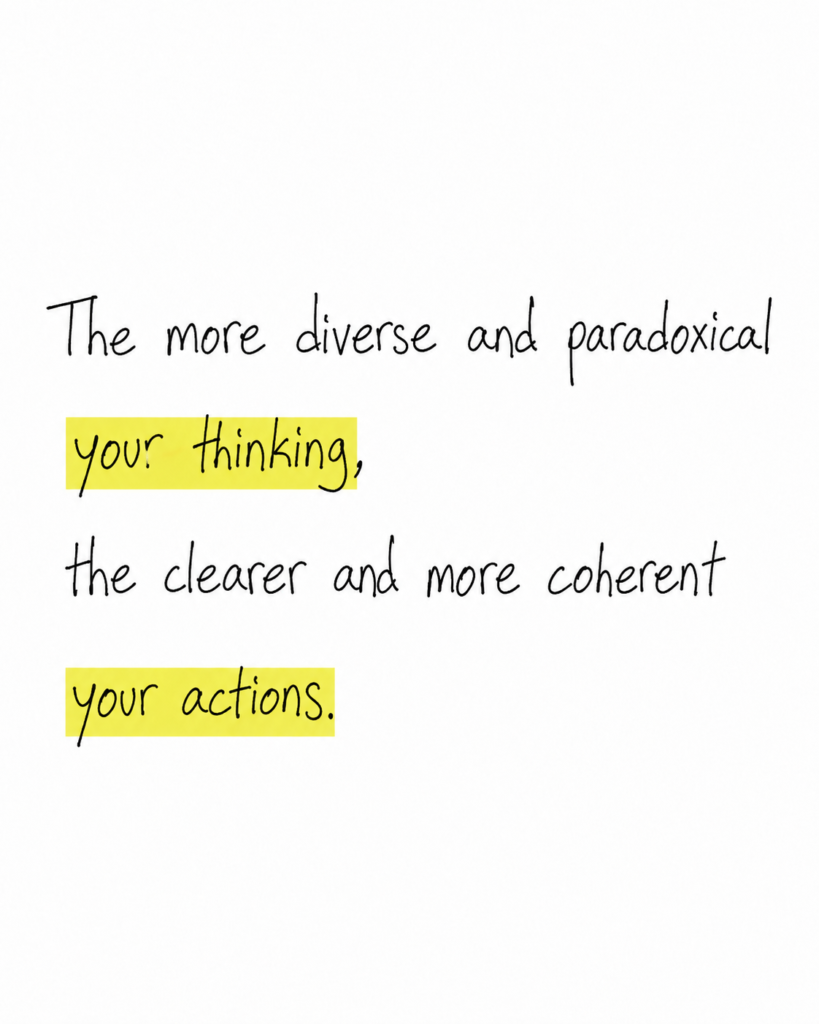
We often falsely assume we have to execute on tasks as quickly as possible.
That’s why we also believe we should rush and keep our thinking simple to get stuff done.
That might be true in some cases, but it’s wrong in most.
Why?
If we don’t take enough time to think, to challenge, to analyze, and to discuss and critically review with others, there’s a high probability we’ll miss important points and insights.
As a result, there’s a high probability we’ll do ineffective or even wrong things.
I’ve observed that the best leaders ask of themselves and their teams to deliberately explore what’s unknown, and what might seem conflicting and unsettling at first glance. Only to realize that the deeper you dive into it and look at it from different angles, the clearer it gets.
Try out the following proven techniques to stimulate your paradoxical thinking:
- Argue the strongest version of the position you disagree with until you can state it better than the person who holds it
- Write your own decision down in the third person, using your name, then advise that person the way you’d advise a colleague
- Ask what would have to be true for the option you’ve already dismissed to be the right one
- Before you start, declare the plan has already failed a year from now and have everyone write down what killed it
Therefore, once you come to implement actions, those measures will be more pragmatic and more consistent with what’s required. Quite a lot of the actual work has been done before.
A word of caution though. The art of applying diverse and paradoxical thinking lies in the ability to balance thoughtful reflection with life’s reality of getting things done.
In other words, be mindful to resist the temptation of overthinking to avoid accountability. Especially when things are actually clear or have already been discussed and decided.
If you’d like to learn more about critical thinking, curiosity, creativity, and others, you might be interested in my new book HUMA, which presents what I call Human Power Skills that enable leaders and teams to develop their unique human skills to thrive in the AI era.
Kind regards,